

<img height="1" width="1" alt="" style="display:none" src="https://www.facebook.com/tr?id=1573404252890905&amp;ev=PixelInitialized">

Great care starts here.

Wound and Vascular Center

CALL 317.346.2700

FAX 317.346.2701

Advanced wound care.
Personalized treatment.
Proven local outcomes.

The Wound and Vascular Center provides specialized outpatient care for chronic, non-healing, and complex wounds. Through our partnership with Healogics®, the nation’s leading provider of advanced wound care, our physician-led team uses a multidisciplinary approach to evaluate each patient’s unique health needs and develop an individualized treatment plan.

Advanced treatment options may include debridement, offloading or total contact casting, negative pressure wound therapy, cellular and tissue-based products, and hyperbaric oxygen therapy when appropriate. These therapies are designed to support healing, reduce complications, and help patients return to a better quality of life.

In the past 12 months, our center has achieved an 82% comprehensive heal rate and a 92% patient satisfaction rate, demonstrating our ongoing commitment to clinical excellence and patient-centered care.

Center-of-Distinction-Award-White_2025-1Honored for Excellence

Johnson Memorial Health’s Wound and Vascular Center has been named a 2025 Center of Distinction by Healogics®, the nation’s largest provider of advanced wound care services. This award recognizes wound care centers that meet or exceed key clinical and patient satisfaction benchmarks, including strong healing outcomes and high patient satisfaction.

The Wound and Vascular Center has earned this recognition multiple times — 2012, 2017, 2019, 2021, 2022, 2024, and 2025 — reflecting the continued dedication of our physicians, clinicians, leaders, and staff to exceptional wound care and patient-centered outcomes.


Services and Support

At Johnson Memorial Health’s Wound and Vascular Center, we help patients find the cause of chronic wounds and vascular concerns, treat the underlying condition, and support healing through individualized care. Chronic wounds are often complex and may be related to diabetes, poor circulation, vascular disease, pressure, trauma, surgery, or other health conditions.

We evaluate and treat diabetic foot ulcers, venous ulcers, arterial or ischemic ulcers, pressure injuries, traumatic wounds, surgical wounds, burns, vasculitis-related wounds, peristomal skin irritation, and other chronic or non-healing wounds. Our team also cares for patients with leg pain and swelling, lower extremity circulation concerns, venous insufficiency, and other vascular-related conditions that may affect wound healing.

Services may include advanced wound dressings, debridement, compression therapy, negative pressure wound therapy, cellular or tissue-based products, total contact casting/offloading, hyperbaric oxygen therapy when appropriate, ultrasound evaluation related to wound care, and vein treatments.


Treatment Focus 

At Johnson Memorial Health’s Wound and Vascular Center, treatment begins with understanding why a wound is not healing. Our team evaluates each patient’s wound, circulation, overall health, mobility, swelling, and risk factors to develop an individualized care plan focused on healing.

Through our partnership with Healogics®, our center offers access to advanced wound care treatments designed to support the body’s natural healing process and address barriers that may delay recovery. Healogics describes advanced wound care as including treatments such as negative pressure wound therapy, biologic or biosynthetic dressings, growth factor therapies, and hyperbaric oxygen therapy when appropriate.

Your individualized treatment plan may include:

  • Advanced wound dressings and topical treatments
  • Debridement, or removal of damaged tissue
  • Compression therapy and edema management
  • Negative pressure wound therapy
  • Cellular or tissue-based products, sometimes referred to as bioengineered skin substitutes
  • Hyperbaric oxygen therapy, when clinically appropriate
  • Total contact casting and other offloading techniques
  • Non-invasive vascular assessment
  • Ultrasound evaluation related to wound care and circulation concerns
  • Vein evaluation and treatment for appropriate patients
  • Customized treatment protocols for complex or atypical wounds

The goal is to identify what may be preventing healing, treat the underlying concern, and support each patient’s progress toward improved function, comfort, and quality of life.


By the Numbers

Chronic and Non-Healing Wounds

Chronic wounds affect millions of Americans and can interfere with mobility, comfort, independence, and quality of life. A recent wound care burden update estimates that chronic wounds affect about 1 in 6 Medicare beneficiariesapproximately 10.5 million people — and cost Medicare an estimated $22.5 billion annually.


A wound may benefit from specialized care if it has not begun to improve within two weeks or is not healing as expected. Early evaluation can help identify barriers to healing, such as diabetes, poor circulation, swelling, pressure, infection risk, nutrition or other underlying health conditions.

Diabetic Wounds and Foot Ulcers

Diabetes is one of the most common health conditions associated with chronic wounds. The CDC estimates that 40.1 million people in the United States have diabetes, or about 12% of the U.S. population.


People with diabetes are at higher risk for wounds because diabetes can affect circulation, sensation, immune response, and the body’s ability to heal. Research published in Diabetes Care reports that the lifetime risk of developing a diabetic foot ulcer is approximately 19% to 34% among people with diabetes.


Specialized wound care can help evaluate diabetic foot ulcers, neuropathic wounds, pressure areas, skin breakdown, and other lower-extremity concerns before they become more serious.

Leg Swelling, Circulation Concerns and Venous Ulcers

Leg swelling, heaviness, aching, skin discoloration, slow-healing wounds, and lower-extremity circulation problems can be signs of vascular or venous disease. Venous leg ulcers are one of the most common types of chronic lower-extremity wounds. A 2023 systematic review found a pooled venous leg ulcer prevalence of 0.32% and incidence of 0.17%, though rates vary by population and study design.


At the Wound and Vascular Center, patients may be evaluated for concerns related to venous insufficiency, leg swelling, lower-extremity circulation issues, and wounds affected by poor blood flow or fluid buildup. Services may include non-invasive vascular assessment, ultrasound evaluation related to wound care and circulation concerns, compression therapy, edema management, and vein treatment for appropriate patients.


Technology to Help Heal

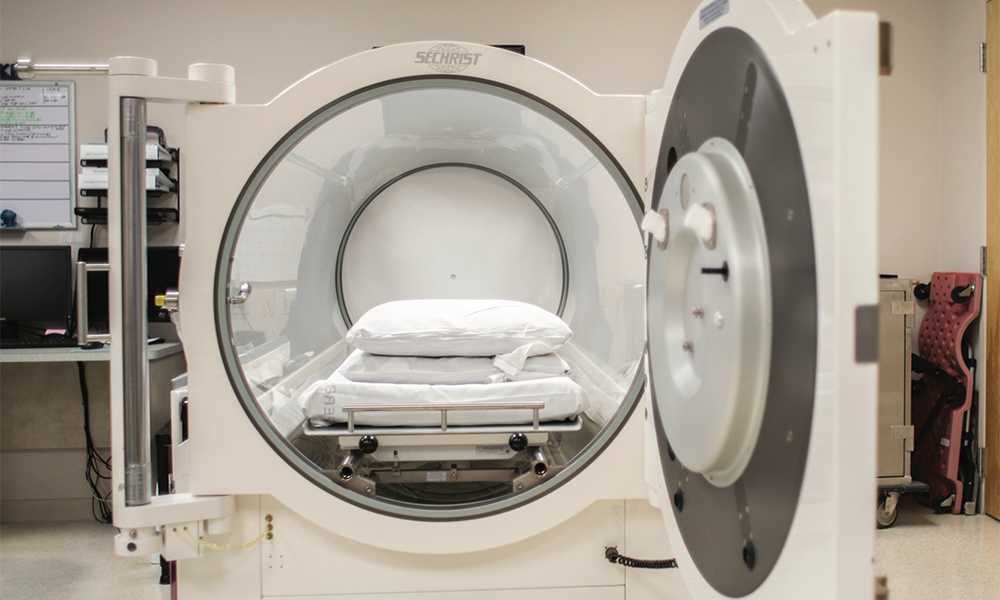
The hyperbaric oxygen therapy chamber at Johnson Memorial Health’s Wound and Vascular Center. Hyperbaric Oxygen Therapy, or HBOT, is an advanced treatment option used for certain medical conditions and non-healing wounds.

During HBOT, patients rest comfortably inside a clear, pressurized chamber while breathing 100% oxygen. This increased oxygen may help support healing in injured tissue when clinically appropriate.

Patients can see outside the chamber during treatment and may watch TV or a movie while they relax.

Learn more about HBOT and how it may support wound healing.

LEARN MORE
Hyperbaric Oxygen Therapy